Setting for Replace a DP/DP Coupler Siemens

Labels: , , , , ,

QUESTION:
How do I replace a DP/DP coupler with the order no. 6ES7 158-0AD00-0XA0 with a DP/DP coupler with the order no. 6ES7 158-0AD01-0XA0?

ANSWER:

Compatibility
The DP/DP coupler with the order number 6ES7 158-0AD01-0XA0 is compatible to the DP/DP coupler with the order number 6ES7 158-0AD00-0XA0:

  • The diagnostic information for the sync and freeze mode for the coupler with the order number ...-0AD01-... has been improved in comparison to the DP/DP coupler with the order number ...-0AD00-... and correspondingly adapted to the PROFIBUS norm.
  • The DP/DP coupler with the order number ...-0AD01-... can be used as a replacement for predecessor modules. The design is compatible.

Exchanging the DP/DP coupler
Follow this procedure to exchange the DP/DP coupler. The individual steps are described below.

  • Transfer the switch settings
  • Dismantle the old DP/DP coupler
  • Mount the new DP/DP coupler

Transferring the switch settings

  1. Note the PROFIBUS addresses (DIL switch 1 to 64) from the old DP/DP coupler and set the identical PROFIBUS addresses on the new DP/DP coupler. The following applies:
DP/DP coupler (...-0AD00-...) = = DP/DP coupler (...-0AD01-...)
DP1 (DIL switch 1 bis 64) = = DP1 (DIL switch 1 bis 64)
DP2 (DIL switch1 bis 64) = = DP2 (DIL switch 1 bis 64)
Setting "0" = = Setting "OFF"
Setting "1" = = Setting "ON"
  1. Transfer the diagnostics settings from the old DP/DP coupler:
DP/DP coupler (...-0AD00-...) = = DP/DP coupler (...-0AD01-...)
DP1 (diagnostics) = = DP1 (DIA)
DP2 (diagnostics) = = DP2 (DIA)
Setting "0" = = Setting "OFF"
Setting "1" = = Setting "ON"

  1. Set the DIL switch "PS" (Power Supply). Only the new DP/DP coupler has a "PS" DIL switch with following settings:
    • PS (DP1) to “ON”: L+/M (PS1) is connected to DC 24 V
    • PS (DP2) to “ON”: L+/M (PS2) is connected to DC 24 V

We recommend the following procedure for switching to the new DP/DP coupler:

  • Connect the power supply for the DP/DP coupler to "PS (DP2)"
    (see section "Mounting the new DP/DP coupler", step 3).
  • Set the PS DIL switch (DP1) to "OFF".
  • Set the PS DIL switch (DP2) to "ON".
  1. Set the DIL switch "ADDR". Only the new DP/DP coupler has a "ADDR" DIL switch with following settings:
    • ADDR to “ON”: The DP/DP coupler gets the PROFIBUS address from STEP 7.
    • ADDR to “OFF”: The DP/DP coupler gets the PROFIBUS address from the DIL switch.

We recommend the following procedure for switching to the new DP/DP coupler:

  • Set the DIL switch on DP1 and DP2 to "OFF". This means that the PROFIBUS addresses will be read directly from the DIL switch.

Dismantling the old DP/DP coupler

  1. Turn the power supply for the DP/DP coupler off.
  2. Pull the bus connector plug out of the PROFIBUS DP interface.
  3. Pull out the power supply of the defective DP/DP coupler.
  4. Loosen the screws of the DP/DP coupler that secure the DP/DP coupler to the rail.
  5. Swing the DP/DP coupler off the rail.

Mounting the new DP/DP coupler

  1. Hang the new DP/DP coupler on the rail and swing it down.
  2. Screw the DP/DP coupler tight.
  3. Connect the power supply back to the DP/DP coupler. Make sure that you have made the correcting setting on the "PS" DIL switch (see section "Transferring the switch settings ", step 3) .
  4. Insert the bus connector plug in the PROFIBUS DP interface.
  5. Switch on the power supply for the DP/DP coupler.

Further information
A detailed description of the DP/DP coupler is available in the documentation of the DP/DP coupler.

Keywords
DP/DP coupler, exchanging, DIL switch, setting


PC Adapter (Interface Cable) for Siemens

Labels: ,

The Programming Cables

There are three major types of programming cables:

1. The CP5512 card in a PCMCIA slot.

2. The PC Adapter using a serial or USB connection

3. An Ethernet cable

The CP5512 card and the PC Adapter can communicate on either an MPI or PROFIBUS port. Note that PROFIBUS is labeled as DP on the Siemens connection ports. These cables can piggyback on existing connectors. Be aware that the PC Adapter draws its power to work from the connection port so check the power LED for proper operation. The CP5512 card draws its power from the computer.

For Ethernet (TCP/IP) use a standard Ethernet cable from the computer to a CPU with an Ethernet port, a CP 343/443 module or a network switch all ready attached to the PLC network.


Omron CX-ONE Software

Labels: , ,

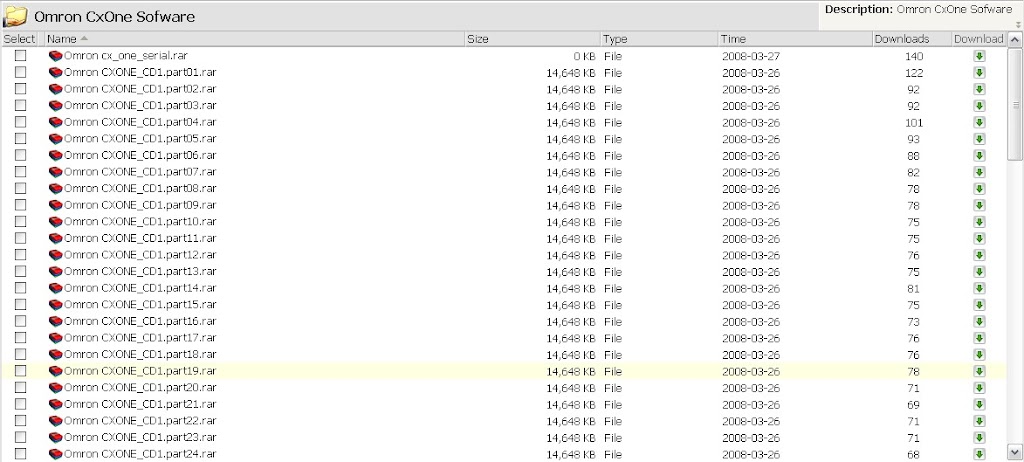
Hi blogger.. I just hunting CX-ONE (Omron PLC Software).
Surprise... I got it from 4shared.com. Look at capture screen below.

You can visit : http://www.4shared.com/dir/6162497/d9777701/Omron_CxOne_Sofware.html

I suggest this software use only for learning. If you use for business Please buy from Omron.
Visit more information at Omron Site.


10 skills developers will need in the next five years

Labels:

If you’re a developer looking to get ahead in your field (or in some cases, to simply stay employed), this is not a good time to be complacent. Justin James lists the skills you’ll want to work on now to maximize your future job prospects.


With the recent changes in the economy, a lot of developers are focused on their short-term job prospects. At the same time, it’s important to make sure that you get the most bang for your buck when it comes to taking the time and energy to learn new skills. Here is our list of 10 skills you should be learning right now to make sure that your resume is relevant for the next five years. The list is hardly exhaustive, and there are huge swaths of the industry it won’t cover (mainframe developers, for example). Nonetheless, for average mainstream development, you can’t go wrong learning at least seven of these skills — not only to the point where you can talk convincingly about them at a job interview, but actually use them on the job.

Note: This article is also available as a PDF download.

1: One of the “Big Three” (.NET, Java, PHP)

Unless there is a radical shift in the development world (akin to an asteroid hitting Redmond), most developers will need to know at least one of the Big Three development systems — .NET (VB.NET or C#), Java, or PHP — for the near future. It’s not enough to know the core languages, either. As projects encompass more and more disparate functionality, you’ll need to know the associated frameworks and libraries more deeply.

2: Rich Internet Applications (RIAs)

Love it or hate it, in the last few years, Flash is suddenly being used for more than just animations of politicians singing goofy songs. Flash has also sprouted additional functionality in the form or Flex and AIR. Flash’s competitors, such as JavaFx and Silverlight, are also upping the ante on features and performance. To make things even more complicated, HTML 5 is incorporating all sorts of RIA functionality, including database connectivity, and putting the formal W3C stamp on AJAX. In the near future, being an RIA pro will be a key resume differentiator.

3: Web development

Web development is not going away anytime soon. Many developers have been content to lay back and ignore the Web or to just stick to “the basics” their framework provides them with. But companies have been demanding more and more who really know how to work with the underlying technology at a “hand code” level. So bone up on JavaScript, CSS, and HTML to succeed over the next five years.

4: Web services

REST or SOAP? JSON or XML? While the choices and the answers depend on the project, it’s getting increasingly difficult to be a developer (even one not writing Web applications) without consuming or creating a Web service. Even areas that used to be ODBC, COM, or RPC domains are now being transitioned to Web services of some variety. Developers who can’t work with Web services will find themselves relegated to legacy and maintenance roles.

5: Soft skills

One trend that has been going for quite some time is the increasing visibility of IT within and outside the enterprise. Developers are being brought into more and more non-development meetings and processes to provide feedback. For example, the CFO can’t change the accounting rules without working with IT to update the systems. And an operations manager can’t change a call center process without IT updating the CRM workflow. Likewise, customers often need to work directly with the development teams to make sure that their needs are met. Will every developer need to go to Toastmasters or study How to Win Friends and Influence People? No. But the developers who do will be much more valuable to their employers — and highly sought after in the job market.

6: One dynamic and/or functional programming language

Languages like Ruby, Python, F#, and Groovy still aren’t quite mainstream –  but the ideas in them are. For example, the LINQ system in Microsoft’s .NET is a direct descendent of functional programming techniques. Both Ruby and Python are becoming hot in some sectors, thanks to the Rails framework and Silverlight, respectively. Learning one of these languages won’t just improve your resume, though; it will expand your horizons. Every top-flight developer I’ve met recommends learning at least one dynamic or functional programming language to learn new ways of thinking, and from personal experience, I can tell you that it works.

7: Agile methodologies

When Agile first hit mainstream awareness, I was a skeptic, along with many other folks I know. It seemed to be some sort of knee-jerk reaction to tradition, throwing away the controls and standards in favor of anarchy. But as time went on, the ideas behind Agile became both better defined and better expressed. Many shops are either adopting Agile or running proof-of-concept experiments with Agile. While Agile is not the ultimate panacea for project failure, it does indeed have a place on many projects. Developers with a proven track record of understanding and succeeding in Agile environments will be in increasingly high demand over the next few years.

8: Domain knowledge

Hand-in-hand with Agile methodologies, development teams are increasingly being viewed as partners in the definition of projects. This means that developers who understand the problem domain are able to contribute to the project in a highly visible, valuable way. With Agile, a developer who can say, “From here, we can also add this functionality fairly easily, and it will get us a lot of value,” or “Gee, that requirement really doesn’t match the usage patterns our logs show” will excel. As much as many developers resist the idea of having to know anything about the problem domain at all, it is undeniable that increasing numbers of organizations prefer (if not require) developers to at least understand the basics.

9: Development “hygiene”

A few years ago, many (if not most) shops did not have access to bug tracking systems, version control, and other such tools; it was just the developers and their IDE of choice. But thanks to the development of new, integrated stacks, like the Microsoft Visual Studio Team System, and the explosion in availability of high quality, open source environments, organizations without these tools are becoming much less common. Developers must know more than just how to check code in and out of source control or how to use the VM system to build test environments. They need to have a rigorous habit of hygiene in place to make sure that they are properly coordinating with their teams. “Code cowboys” who store everything on a personal USB drive, don’t document which changes correspond to which task item, and so on, are unwelcome in more traditional shops and even more unwelcome in Agile environments, which rely on a tight coordination between team members to operate.

10: Mobile development

The late 1990s saw Web development rise to mainstream acceptance and then begin to marginalize traditional desktop applications in many areas. In 2008, mobile development left the launch pad, and over the next five years, it will become increasingly important. There are, of course, different approaches to mobile development: Web applications designed to work on mobile devices, RIAs aimed at that market, and applications that run directly on the devices. Regardless of which of these paths you choose, adding mobile development to your skill set will ensure that you are in demand for the future.


Sumber: http://techrepublic.com.com/


The MSD™ (Multi-Stage Dryer)/ FSD™ (Fluidized Spray Dryer)

Labels:

Nah kalau pengen tahu tentang, spray dryer. Mesin yang digunakan pada industri-industri food dairy. Salah satu teknologi yang digunakan untuk menggubah susu cair menjadi bubuk, menggunakan sistem ini. Silahkan baca-baca untuk lebih jelasnya. Semoga bermanfaat.

A
MSD™ (Multi-Stage Dryer)/ FSD™ (Fluidized Spray Dryer) is a dryer that
combines spray drying and fluid bed drying technologies. Through the
process it produces coarse, agglomerated, free-flowing dustless powder.
This drying principle was first introduced in the early 70'es by using
the VIBRO-FLUIDIZER™ for the final drying.

A new dryer concept
GEA
Niro has always focused on developing dryers with improved energy
efficiency and final product quality, and in order to improve the dryer
efficiency even further, without deposit problems in the chamber, a
completely new spray dryer concept - named MSD™ (Multi-Stage Dryer) -
was developed around 1980. Since then GEA Niro has delivered more than
300 plants with the MSD™/FSD™ concept.


Drying in more stages

The first necessary step to reach the concept of the MSD™ was spray drying
in two stages. The MSD™/FSD™ operates with three drying stages, each
adapted to the moisture content prevailing during the drying process.
In the preliminary drying stage the concentrate is atomized by
co-current nozzles placed in the hot drying air duct.

The
air enters the dryer vertically through the air disperser at high
velocity, ensuring optimal mixing of the atomized droplets with the
drying air. The evaporation at this stage takes place instan-taneously
during the passage vertically down through the specially designed
drying chamber. In this primary drying stage the particles reach a
moisture content of 6-15 %, all depending upon the type of product.

Second-stage drying
At
such high moisture content the powder will exhibit high thermo
plasticity and becomes very sticky. But the design and air flow pattern
in the MSD™ plant is created in a way, that prevents the particles from
sticking to the drying chamber, but be led directly into the integrated
static fluid bed for the second-stage drying.

The integrated
static fluid bed is supplied with air at a sufficient velocity and
temperature for the second stage drying. The drying air from the
preliminary drying stage and the subsequent second-stage drying leaves
the chamber from the top.

VIBRO-FLUIDIZER- final drying and cooling
When the powder has reached a certain moisture content, it is discharged via a rotary valve into a VIBRO-FLUIDIZER™
for the final drying and subsequent cooling. The drying/cooling air
from the chamber and VIBRO-FLUIDIZER™is passed through a cyclone,
separating the powder contained in the air. The fine powder is returned
back to the atomization device, the chamber cone (static bed), or the
VIBRO-FLUIDIZER™ depending on the requirements to the final powder bulk
density. On today's modern dryers the cyclone(s) are replaced by a CIP-able bag filter.

Powder structure
The
high velocity air inlet for the primary drying is creating a venturi
effect, the vacuum of which will suck surrounding air - with entrained
fines particles - into the wet atomizer cloud. This will result in a
"spontaneous agglomeration"

The powder will therefore exhibit
a coarse powder structure o riginating from this agglomeration in the
atomizer cloud. Further there is a continuous supply of dry fines
particles from the cyclones/bagfilter that will stick to the semi-dry
particles enhanching the agglomeration. For non-agglomerated powders
all fines from the cyclone/bag filter are returned to the VIBRO-FLUI DIZER™.

It
has been possible to operate this plant at a very high primary drying
air temperature (220-275 C) and an extremely short residence time,
still maintaining a good solubility of the powder. The physical
dimensions of this type of plant are small, and thus the requirements
to the size of the building are limited.

This together with
the improved drying economy (10-15 % less compared to conventional
two-stage drying), due to the high primary drying air temperature,
makes it a very attractive solution, and is today the preferred dryer
for top quality products like cold-water instant whole milk powder and infant milk formulas/baby foods. To improve the drying economy further a heat recovery system can be installed.

Source: www.niro.com


Mengenal Proses Batch Mixing

Labels:

General Description

The batch-mixing system for mixing liquid products is a moderately priced solution for the automation and modernization of the preparation area. Its small dimensions permit an easy integration even into an existing system.

Special features of the system:

  • Constantly high product quality
  • Optimum use of raw materials without overfeeding
  • Easy and lossfree product change
  • Work facilitation for the personnel in the preparation area
  • Low wear and tear and, as a result, low maintenance.


The batch-mixing system is arranged between the concentrates storage on the one side and the mixing tanks on the other side. In addition to the above-mentioned features, the concept of the system still considers the following advantages:

  • High accuracy and reproducibility
  • Suitability for CIP
  • Safety against unintended mixtures
  • Safety against operating errors
  • Extensive monitoring of the system to avoid any switching and measuring errors or product deficiency
  • Automatic switch-off compensation
  • Batch logging


The selection of the best suitable flow meter is dependent on the product properties (viscosity, conductivity, etc.), the minimum quantities and the total flow rate of the system. The system is tubed and compactly mounted on a stainless steel base frame. The electric and pneumatic connections are established at the factory, i.e. the remaining assembly work to be done in situ is very low.

Example Scheme


Water and concentrates or essences are connected to the ingredients valves, which are designed as T-shaped valves with the effect that the free-flushing process is not affected by any stagnant spaces. The mixing tank is linked to the outlet line of the mixing system, which is completely filled with water, i.e. it is used as a so-called "full hose system" to guarantee an optimum accuracy. After the start, the preselected recipe is automatically processed, which means that concentrates and water are successively fed in the desired sequence. The concentrates are conveyed by a builtin pump. Water should bypass the concentrates pump at a higher capacity by means of an external pump. The concentrates pump is running at the same time in order to remove any concentrate residues. A 2-stage valve at the outlet of the system permits an accurate shut-off after each ingredient has flown through the system.

The deaerating and test vessel contains some level probes for the following functions:
  • System stop in case of product deficiency
  • Automatic deaeration
  • Accuracy test of the flow meter
When the batch has been passed through, the system is again filled with water, and the start of the same or a different product is possible.


Statistik Situs Belajar PLC & SCADA

Labels:

Hi Blogger dan sahabat-sahabat....

Hari ini gue coba nih track situs ini biar tahu berapa pengunjung rata-rata untuk setiap minggunya. Coba lihat grafik di bawah ini.


Bagi teman-teman yang merasa situs ini membawa manfaat dan layak untuk konsumsi mahasiswa atau automation engineer. silahkan beritahu teman-teman anda dengan cara mengklik gambar/tombol share di bawah ini.

Thanks untuk kunjungannya.

Salam,
Belajar PLC dan SCADA